9.1.12

When Simple Things Speak

Off

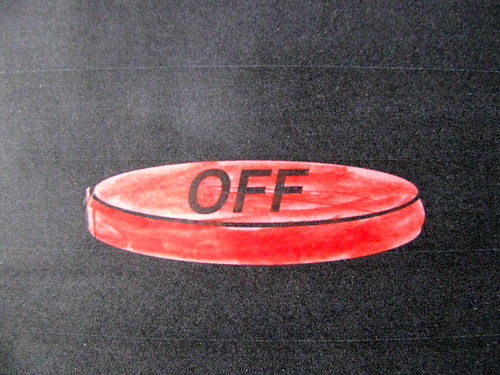
It has always been this way for me. The simplest things speak. Last night, tidying up the living room, I saw this Off button my littlest daughter made, for one of her animation projects.

Standing by the coffee table, I stopped moving and stared. Struck, yes, that's how I felt. You'd think I had been visited by an angel.

But I was not afraid.

Just very still.

And the simple red Off button has been speaking to me ever since.

Labels: , ,

5.12.11

Knitting Yourself (or Someone Else) into Silent Peace

Knit One Purl a Prayer

"Oh, that's girl stuff—you guys wouldn't be interested. But I do find it contemplative," she said to her husband and their friend Brother Anthony.

Thus opened the moment when Peggy Rosenthal discovered that the Desert Fathers wove baskets while they were at prayer. And, said Brother Anthony, since it was the *process* of weaving the basket that mattered, the Fathers sometimes burned their baskets afterwards.

Peggy finds the process of knitting (a kind of weaving) calming. And, like another woman she heard about, it sometimes helps her "knit herself into the silent peace at the heart of the Divine Presence."

But Peggy doesn't burn the work of her hands. Work has its place too—no less the kind that builds something along the way. This building, it can be touchingly beautiful, as when, she recounts, one Prayer Shawl Ministry group knitted a shawl for a friend facing divorce. The shawl—was it not moments of touch, knitting the hurting woman to other hearts, even as the woman was losing a heart she'd come unraveled from?

I sit here this morning and think that peace is a process. A slow knitting, sometimes of what has come unraveled, sometimes of new yarn, new moments yet to be placed clearly in space and time.

And I think my fingers are their own kind of knitters. Picking up letters and passing them through loops, making shawls for those in need of shelter and warmth.

Labels: ,

17.11.11

Knit One, Purl a Prayer

I "met" Peggy Rosenthal when she did a lovely review of Maureen Doallas's Neruda's Memoirs.

Now, reading the preface to Rosenthal's new book, Knit One, Purl a Prayer, I realize that when I first "met" her I had noticed the Jewish name but not *really* noticed. Peggy reminds me in her Preface: Judaism was the faith of her cradle days, though it was practiced mostly on High Holy Days.

As she lays out an invitation to join her on a knitting journey, albeit not asking us to come with yarn in hand, I am struck that she has found a way to be both Christian and Jewish. By this I mean that though she is now Catholic, she embraces the physical as a way to the transcendent. And that reminds me of the jubilance of Jewish festivals, filled with things to touch and taste, as reminders of the spirit in the surface of things. Of course, that is quite Catholic too, and so it seems fitting that this is where she found her place upon conversion.

I am not a knitter, anymore. Though my grandmother once taught me, and if I close my eyes I can remember the click of the needles, the feel of the yarn passing through my fingers. So the memories draw me, and I think... Maybe I will journey a little with Peggy. Listen in as she puts needle to needle, knits physical to spirit...

Labels: , , , ,

26.10.11

The Age-Old Struggle

As far back as Babylonian literature (which we have some record of), we humans have storied the struggle of life—a struggle variously cast as chaos versus order, good versus evil, freedom versus oppression.

Our most popular films and books today still probe this dynamic. The good guys and the bad guys are the stuff of action, conflict, and triumph.

Some people believe this has arisen mostly from humanity's struggle with forces of nature. And, needing a way to articulate this struggle and feel some sense of meaning within it, we have turned to myths and spiritual stories.

There is some truth to that.

But there is another truth put forward by the bible: the physical is an extension of the spiritual. The "battles" we experience within the world and ourselves are rooted in another dimension.

This is the subject of chapter 8 of Sanctuary of the Soul.

The other day my daughter and I watched a TED talk about the universe. Even the physicist who presented it admitted he could not completely wrap his mind around what I would call the eternal nature of matter and dark matter. Even the universe presents us a mystery and a drama and a wondering: will there be a happily ever after? who controls this, if anyone?

Watching the talk, I suddenly felt how small I am and how large is the mind of God. If Satan is simply an angel, he too is small in comparison. Perhaps this is all we need remember. This, and the practice of seeking the Mind that rules not just this world but all that is beyond it and beyond and within time.

As Foster notes, we might be tempted to consult lesser things, and these might bind us: witchcraft, astrology, tarot, palmistry, spirit guides, Ouija boards. They might give us the illusion that we control our share of the world and the universe.

Why live in that place? When we can live in the Eternal, through the connection of Christ and his Spirit?

Labels: , ,

22.10.11

Yellow Flames Flutter

The other night I pulled out my house copy of InsideOut. Not sure why. Maybe because it had somehow turned up at my bedside. And the solitude it had poured from seemed to be calling.

I realize that many of the poems are just glimpses, like this one...

Kale is purpling,
bluing and
purpling.


Or this one...

Little lemon tongues,
wagged off at last.


And this one...

Lightning flashes
and I write
of yellow leaves.


There are longer poems in the book too, but these are the kinds that solitude evoked—a simple focusing on one vision. An awe, if you will, and a willingness to capture that awe in very few words.

So you will not be surprised when I was pleased by Chapter 7 of Sanctuary of the Soul, which suggested poetry (reading or writing it), as a way to embrace silence and release ourselves from distraction.

Foster shares this poem from Robert Siegel...

Yellow flames flutter
about the feeder:
A Pentecost of finches.


Where does Siegel (or anyone?) come up with something like that? First the heart must see... and flutter. Near the feeder, in the yard, perhaps beside a lake or the sea.

Labels: , , ,

19.10.11

The Voice of God

I know people who claim to hear the voice of God. Sometimes I think they are simply hearing their own wishes.

The human brain has an amazing ability to see patterns, to find or create meaning. We are seekers of symmetry. For this reason, sometimes I have been a person who thought she heard the voice of God, when perhaps I was simply making meaning I wanted to make, when I was collecting pieces for some desired symmetry.

At times I have, therefore, felt very down about the whole voice-of-God issue.

I don't think we will ever get it totally right. Sometimes we are just going to be making stuff up and attributing it to God. Still, if we could even get it right about half of the time, that might move our lives forward in a good way. I would accept those odds, all things considered.

In Chapter 6 of Sanctuary of the Soul, Foster suggests three attributes of the voice of God...

- quality: "a steady, calm force"
- spirit: "peaceful, joyful"
- content: "consistent with [biblical] truths about God's nature and kingdom"

I like these indicators. Maybe it could help me move to the 75% range, if I paid attention.

But even if I never know for sure, I can measure my actions against scripture and church tradition—the voice of God as experienced by a cumulative community over time. It is not all up to me. I can hear through the ears of others who have blessed the world.

Labels: , ,

11.10.11

Swallow What You Have Tasted

Gazing on God. If it sounds abstract, then perhaps we need a concrete way to come to it.

In Chapter 5 of Sanctuary of the Soul, Foster suggests three ways...

• behold in Creation
• listen to worship music
• sit in silence

If I were to put deeper words to this, I would take us to the biblical festivals that eventually informed the Church Calendar. I would take us especially to Sukkot.

During Sukkot, the people of Israel built huts outdoors. The huts were mostly open to the sky. And here they spent time eating and sleeping, the very air and its currents reminding them of Spirit breath. Tasty fruits, vegetables, song, silent nights under the stars: it was all there.

My church tradition has very little connection to such ancient festivals or even a modern Church Calendar. And many a day I think this is why we can't, as Foster quotes it, "swallow what [we] have tasted." Or maybe we can't even taste to begin with.

I've done little things with my own family, to try to recapture such concrete experiences of God. But I do wish for a wider community that could teach and support and extend such ways... to help me taste, and see, and swallow the glory of God.

Labels: , , ,

8.10.11

Collecting Ourselves and Something Else

The poet William Wordsworth defined poetry as "the spontaneous overflow of powerful feelings: it takes its origin from emotion recollected in tranquility."

I love that word "recollected." Something about the sound of it.

And it is that word, hyphenated by Foster into its two parts re-collected, that stood out to me in Chapter 4 of Sanctuary of the Soul.

While Foster spoke of psychological relaxing and surrendering, through sitting still and maybe going over a Scripture in one's mind, I was somehow thinking of daffodils, and how Wordsworth once wrote of them...

For oft, when on my couch I lie
In vacant or in pensive mood
They flash upon that inward eye
Which is the bliss of solitude;
And then my heart with pleasure fills,
And dances with the daffodils.


Thinking of the daffodils, I remembered how psychologically relaxing it had been to spend time outdoors every day for a year. So relaxing, in fact, that my body began to develop a new 4-o'clock sense of longing for solitude and fresh air and my cup of tea. A "pattern of life" (as Foster puts it) had developed, and from it came deep times of collection— collection of images, truths, inner spaciousness. I wrote more poetry during that time than I ever have or have done since. I re-collected the past and somehow came out with a larger sense of love.

I don't sit outside daily anymore. It had its time and place. The other day, in Wordsworth style, I allowed myself to simply lie on the couch. The afternoon sun was warm on my arm and I fell asleep. I woke up filled with so many little epiphanies it was almost overwhelming.

Is it important how we go about collecting and re-collecting ourselves? I'm not so sure it is. Sitting still in a chair, going outside with a cup of tea, lying down on the couch in the afternoon, with a sense of wanting to know anew: each can be a basket into which we gather refreshment, vision, and love.

Labels: , ,

6.10.11

Steve Jobs, Time, and the Meadow

"He was an amazing man," I said to my Littlest. She looked into my eyes, knew that I was about to cry, and a sweet "I'm so sorry" flowed through her gaze. I read the obituary aloud. We talked of Apple technologies we love, and she was fascinated to learn about the man who brought them to her life.

Through the rest of the evening I kept considering how time was not Steve Jobs' friend. I thought about others like him, who have been as a "candle in the wind." I thought of one of my favorite story tellers, Flannery O'connor. All those who, so brilliant, have died young, leaving the world wondering what it missed because of their early leaving.

Today I noticed this phrase in Chapter 4 of Sanctuary of the Soul: "time was our friend."

Foster was speaking of an experience at a place called Quaker Meadow—a place where, for a day, time seemed to stand still.

Sometimes I think such moments are a hint of eternity. Time is not really our friend; life can never be long enough. But in our Quaker-Meadow moments we taste a hope that we will live on in the mind and heart of God. And we will not go missing from the world.

Labels: , ,

4.10.11

Windows to Heaven

Just when I settled on my way, I found that Foster's text turned; it would be a stretch to try to find a breath prayer in Chapter 3 of Sanctuary of the Soul.

That is fine. In fact, it seems often to go this way in spiritual life. We settle on a process, a path, and something shifts.

The shift in this case was from the cerebral to the creative, from words to visions and connections. Foster discussed three “windows to heaven”: the imagination, lectio divina, and the community of the saints.

Most interesting was the brief discussion of imagination and how, in its way, it also infuses lectio and our understanding of community past and present. This is prayer turned painting (especially through the use of icons), prayer absorbed in pictures and a washing-over, prayer as a heritage we share with generations before us.

My favorite quote was, “allow the Lord to give you many delightful images and pictures of God’s desires for humanity.”

I am reminded of the work of scientist John Medina, who discusses how the lion’s share of our brains is given over to the visual. I’m not sure how this works for someone who can’t see, though I imagine that, in vision’s stead, touch can give shape to some kind of “visual” construction. In this case, it would be one of hopeful connections, grace-full constructions.

So I come to this today: God who sees, let me see. A breath prayer, after all.

Labels: , , ,

29.9.11

Turning Words into Prayer

I have decided that what I am reading is a devotional. I have to decide this, to frame my experience with it and be sure to take something away. Perhaps this way you'll not tire of me, and I'll not tire of finishing Sanctuary of the Soul: Journey into Meditative Prayer.

As such, I will find a few words from each chapter and make them my morning's breath prayer.

Today, in the silence of this room, sipping my Green Tea Echinacea, I breathe in...

God of beautiful vision

I breathe out...

transform my heart

Transformation of the heart is the concept I pulled from Chapter 2 of the book. Oh, that it would be so simple as to pull heart-transformation from words. And wouldn't it be marvelous if I didn't experience fear in the very praying of such uncomplicated words. Maybe this is part of the power of a breath prayer. With each repetition, we can unwittingly delve into layers of fear, hopes, argument and embrace.

Another sip of tea now, and this...

God of beautiful vision, transform my heart.

Labels: , , ,

27.9.11

Wishing for the Sanctuary

Spiritual Practice Books

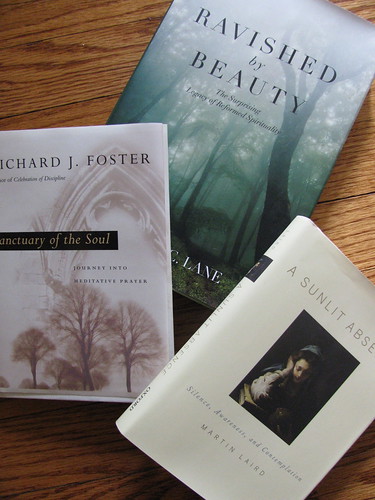
The last book in my little project pile is Sanctuary of the Soul: Journey into Meditative Prayer.

I opened the book a bit hopefully. Such a beautiful cover, and I love the title. But I find myself feeling the opposite of when I started Ravished by Beauty.

After reading just the prologue of Ravished by Beauty I held my breath, hoping the book would continue in the promise it began: to be fresh, informative, lyrical, provoking. (It kept its promise.)

But on this quiet, foggy, silent morning—reading the introduction and the first chapter of Sanctuary—I am somehow feeling like I've gone to hear a church sermon, one that is tired and strung together by bible stories that should be powerful but somehow don't feel powerful at all.

Of course I am partial to Foster's observation that biblical meditation often included "silent reflection upon God's works in nature." And my favorite part of the chapter was a snippet that explains two Hebrew words: haga and stach. Our bibles, he notes, often translate these words as "meditate," but they are more nuanced than that, suggesting...

to mutter, to moan, to whisper, to reflect, to rehearse, to muse and even to coo like a dove. (Is. 59:11)

If the book delves more deeply into nuances like these as it goes along, I will perhaps, after all, find sanctuary in its words.

Labels: , , ,

26.9.11

A Gathering Art

When was the last time you were "summoned to amazement" by Creation? Do you have natural "remembered places" that astonish you? Are you engaged in the practice of a "gathering art" as you sit outside on a simple day, or hike a mountain, or walk in the woods? Does any of this move you to love and action?

These are the underlying questions of the final chapter of Ravished by Beauty.

Pulling together ideas about "Calvin's God of beauty, mirrored in creation, and Edwards's communicative God, eagerly seeking ways of multiplying relationships [and glory]," Belden C. Lane makes his crowning pitch to those who profess a deep yearning for God: if we are moved by this yearning it will go beyond words. We will develop, as Edwards noted, "a capacity to delight."

Bringing it home with a concrete example of East St. Louis (across the river from his own residence), where Dead Creek teems with chemicals and ugliness, Lane asks us to test the measure of our delight in Creation (and ultimately in God).

Are we willing to let such places remain stripped of their "natural ability to reflect God's glory"? Are we willing to let the Dead Creeks of our world be silenced in their praise? Likewise, if it is true, as Sandra Steingraber argues in Living Downstream, that "90 percent of all forms of cancer may be attributable to specific environmental factors," can we sit by in silence as praiseless places lead to the eclipse of human voices of praise?

Lane's conclusion is sober, "Failing to exercise the consciousness I possess, I too fail to give praise."

Let us, then, he urges, join our words and actions. Let "the desire of human beings...join in God's own deep longing for beauty."

Maybe it can begin with a simple gathering art. Go outside every day. And, there, listen for the heart of God.

Labels: , ,

24.9.11

And Edwards in the Woods

First I found Calvin in the yard. Then I found Edwards in the woods.

If you're like me, your most prominent memory of Jonathan Edwards is his hell-fire sermon, "Sinners in the Hands of an Angry God."

But Chapter 5 of Ravished by Beauty suggests we might better conceive of Edwards overarching viewpoint as "sinners in the hands of a beautiful God."

As a child, Edwards was known to build prayer huts in the woods. As an adult, says Lane, "he wrote of songbirds, flowing water, and the intricate movement of the stars. He spoke of seeing these things...as the voice of God, glimpsing what is held out to us by the divine hand."

If God can be seen in the beautiful world, as Edwards believed He could, then we humans have a clear role to play. We are what Edwards called "the consciousness of the creation." Lane further explains this, saying, ours is the "responsibility of discerning and articulating the aesthetic/moral character of the cosmos as a mirror of God's glory."

I was most fascinated by Edwards belief that this beauty went down to, as it were, the very bones of the universe. Lane notes that some of Edwards ideas were before their time and we are only just beginning to see scientifically how right he was.

I suspect Edwards would have loved String Theory; he spoke of the world as a "vast orchestra tuning up." I imagine he would have also loved our discoveries about the prevalence of fractals. Even our own brains exhibit this elegant design. Edwards would have called it an image of the glory of God.

Labels: , ,

22.9.11

It Ain't Easy Being Puritan & Narcissistic

Did you know we are selling our cities? I heard about that on the news the other day. Cities that can't keep themselves in financial order have been selling themselves to foreign (and domestic) investors.

I am thinking of various kingdoms throughout the ages that overspent on their desires, only to resort to selling parts of their economies and important land (say like that which had oil reserves) to foreign investors. The end result? These countries went down or lost control of their ability to make their own decisions about resource-use.

I do not know a lot about the selling of our cities; I won't be able to engage in any high-level conversation on the topic. I am not bringing it up to be political. It just seems to be a very practical and pressing example of what happens when our desires exceed our mechanisms for dealing with desires.

The Puritans were fairly clear on this point: they stirred up desire (mightily!), but they balanced it with a cautiousness found in the book of Proverbs. It's a hard balance to strike.

Indulge desire too much and we can become narcissistic. And, oddly enough, deprive and constrain too much and we can also become narcissistic.

Chapter 4 of Ravished by Beauty explores how the Puritans tried to keep a balance. It wasn't easy then, and it isn't easy now.

This brings me back to the practical. I am thinking of a friend who cannot control her own spending. She finally told her husband, "Take the credit card. Give me a cash allowance. I thought I could make this work, but I can't. I don't want to sink this family."

My friend impresses me. She balanced her desires with a constraint that she needed. She chose the Puritan way instead of the narcissistic way. And it was a beautiful thing.

Labels: , ,

21.9.11

The Surprising Puritanism of Ann Voskamp

I remember well the day a displeased blogger made the indictment: Ann Voskamp had trespassed Christian boundaries by writing of her love for God in sensual terms.

There was a lot of back-and-forth, some declarations of "disgusting!", gasps of shock and groans of embarrassment. Some of those responses can still be seen over in the Amazon reviews of Ann's book.

No question, Ann had been... rather forthright. She spoke of consummation. Spirit skin on spirit skin. No self-respecting Puritan could accept such language. This must be the language of secular Enlightenment, or something like that, yes?

Let Chapter 3 of Ravished by Beauty set the record straight. Enlightenment thinkers were embarrassed by the Puritans. The Puritans, surprisingly (perhaps) spoke unabashedly of their relationship to God in sensual language.

While Puritans like Richard Sibbes looked "to consummated union as the ultimate goal of conversion," pastors like Thomas Shepard spoke in words that might have been stolen from Ann, "he makes love to thee... 'Tis fervent, vehement, earnest love...The Lord longs for this...pleads for this...Take thy soul to the Bride-chamber, there to be with him forever and ever..."

John Cotton said it this way, "It will inflame our hearts to kisse him again, if the kisse be from God." And Francis Rous, in a sermon on Isaiah 54:4-5, encouraged his listeners to "fasten on him, not thine eye only, but thy mightiest love, and hottest affection...that thou maist lust after him..."

[blush]

Ann Voskamp seems almost tame in comparison.

Labels: , , ,

20.9.11

Praise Creates the World

I hear it this morning: the praise of rain. If you are a Texas friend of mine, you hear it this morning: the lament of moisture-empty air. I myself put down a book to reach for my daughter when she came in the room a few moments ago, so I could show her my delight... that she is here, a gift to me and to the world.

We are made for praise. And it springs from our response to God's creations.

Chapter 2 of Ravished by Beauty explores the intertwined role of humankind, earth, and its creatures in responding to God—either in praise of his providence through Nature, or in lament of the brokenness of Creation.

It was fascinating to read of Calvin's ideas about the world as God's theater, where we are treated to visions of God's beauty and power and tender love. A theater, however, is not complete without an audience. We are that audience. But not we alone. The trees clap their hands, the deer pants for water... desiring God's power in providing it.

We can ignore God's gifts, God's own delight in Creation and our part in preserving it. To do so, Calvin says, is "to burn the book [of nature] which our Lord has shown us, wittingly undermining the order he has established in nature by playing the butcher in killing the defenseless bird with our own hands..."

One of the more interesting ideas Belden Lane proposed as an outflow of these concepts was not just that we stop hurting the earth and its creatures (for it and they are our cohorts in praise), but that we also seek ways to incorporate them into our liturgies. He asks...

"What have we to learn from wilderness retreats and gardens of prayer, outdoor labyrinths...and fruits and vegetables...brought to the communion table on Sundays and shared with the poor?"

I was also reminded of something I discovered when researching for God in the Yard: some church communities of long ago used to release birds during their services, as a symbol of Divine presence and Spirit. Short of doing this, I suppose we could simply hold services sometimes out-of-doors (and not just at sunrise on Easter Sunday).

In all, the point is praise. For One who sustains the world by his own delight, and, according to Calvin, relies on our delight as an echo, in a partnership of continued creation.

Labels: , , ,

19.9.11

Calvin in the Yard?

Over at Amazon today, I noticed one of the reviews of God in the Yard. It's subject line:

A New Kind of Spiritual Discipline.

I guess it can feel that way. Sitting out in the yard, taking in the gifts of nature (even the mosquitoes, yes :). It can feel like a new thing, to the modern Christian accustomed to a pietistic approach.

It even felt new to me—when I sat under stars in snow or rain—since I come from a church that emphasizes intellectual devotion and abstraction over Creation, the senses, and experience.

You can imagine how fascinated I was this morning, then, to read of the dual-thinking of Calvin and the Puritans, on matters of nature, desire, and even ecology. I hadn't known much about Calvin except the doctrine of predestination. This, I discovered, is owed to some of the theologians who came after him, as they emphasized one side of his ideas over the other.

The best way to share with you my fascination about the lesser-known side of Calvin is to share some of the quotes from Calvin and the Puritans, that were included in Chapter 1 of Ravished by Beauty: The Surprising Legacy of Reformed Spirituality.


William Lawson, on gardening as an aid to spiritual reflection:

"pause with your selfe, and view the end of all your labours in an Orchard: unspeakable pleasure, and infinite commodity"


Nathaniel Ward, Puritan pastor, in a code of laws for the Massachusetts colony:

"No man shall exercise any Tiranny or Crueltie towards any bruite Creature which are usuallie kept for man's use"


John Calvin

"What a pleasure it is to dive into the secrets of nature.... What a deal of the majesty of the great Creator doth shine in the face of this fabric of the world!"

"If I now seek to despoil the land of what God has given it to sustain human beings, then I am seeking as much as I can to do away with God's goodness."


These are not isolated quotes, but just a few of many that Belden C. Lane shares. His discussion is a beautiful balance of thought that might fascinate you too—whether you're sitting at the desk or in the yard.

Labels: , , ,

16.9.11

Into the Rockies and the Wyoming Desert

Spiritual Practice Books

Glancing at my little pile, I thought it best to take what looked like the hardest title next. Hardest, because it seemed more focused on religious thought-traditions than I might enjoy and, also, it's the thickest book in the stack.

So this morning I pulled out Ravished by Beauty: The Surprising Legacy of Reformed Spirituality. I planned to breeze through the Prologue and Chapter 1.

Let's just say I was pressed into a motionless place, my back up against the Rockies and my soul stretched thin across the high desert country of Western Wyoming.

As you might guess, I didn't make it past the prologue.

This is a beautiful book. Woven with sights of Glacier Trails and mountain bluebells, slowed with surprising statements about Calvinism and Puritanism, it will not yield to a quick reading. Of that I am sure.

Of all the quotes next to which I put my little "I love this" dots in the margin, this one seems to capture the main theme, as I understand it so far...

"Calvinism was, in part, the product of a landscape of desire—hardened by affliction, toughened by geography, yet driven by the earth's wild beauty to a God of matchless splendor."

I find myself now piqued with a desire of my own: that this book will continue in the fashion it began. That it will keep its promises and remain as beautiful and thoughtful as the Prologue that opened the conversation about the twin experiences of desire and the "weaning of desire."

Labels: , , ,

15.9.11

On Whether it Works

The final chapter in A Sunlit Absence is an amalgam of thoughts on whether or not contemplative prayer works: as the best choice for prayer, as something suitable for a variety of personalities and lifestyles, as an aid to forgiveness, etc.

I admit I was disappointed by this chapter; it seemed as if it would have been best folded into the rest of the book, piece by piece. And it ended abruptly with one of the potpourri of thoughts, disconnected from any general drawing back to the whole of the book.

There is a part of me that wants to do something other than end like this—with what feels like a review instead of an entering-in. And I am reminded of how important it is for writers to keep their promises to readers all the way through an endeavor, whether that endeavor is an article, a poem, or a whole book.

It is okay, of course, when we writers forget to keep our promises. But our readers may be prone to remember.

____

On a different note, I wonder if any of you have tried contemplative prayer or plan to try it? The rosary, by the way, can be considered a form of contemplative prayer due to its repetitive nature. So far, my girls and I have made rosaries, but I have yet to teach them how to pray with one. (Of course this will mean I'll need to learn it myself first! :)

Labels: , ,

14.9.11

What Voices Are We Hearing?

Now this is one of the trickiest chapters of all.

Chapter 7 of A Sunlit Absence, discusses "sharp trials of the intellect," wherein the person comes to see his faults more deeply—especially faults like vainglory, pride, envy, and judgment.

Why is this tricky?

Because just when we think we are discovering our faults and beginning to "break to pieces" under the weight of them (surely a sign of growth for the Contemplative), we may be doing something altogether different—and that is a kind of codependent acceptance that we are a terrible person, unworthy of people's affections, certainly unworthy of God's.

Is our discovery true?

Christian life carries this risk: we may think we are hearing the Voice of Truth declaring us selfish, unfriendly, arrogant (and as humans, we certainly can be!), when what we really may be hearing are the voices of loss, parental or cultural judgment, or our own self-deprecating fears.

I can think of no good way around this except the Song of Songs and its progression from love, to doubt-and-violence, to deeper love.

In the beginning, the Beloved and her Lover are almost high with love. It is Ideal, each viewing the other as perfect. In the center of the book, there is doubt and violence, as the Beloved has a terrible dream in which she's violated by both her Lover and the world outside their intimate love. In the final scenes, the Beloved comes up from the desert leaning on the arm of her Lover. The language of the Ideal is stripped away, but so is the language of doubt and violence. The Beloved appears tired or weak (as we all are, in the sense that we are "sinners"), yet she is accepted, bonded to her Lover as she leans into him.

What allows this bond? She and her Lover are no longer Perfect, but they do not live in a place of doubt-and-violence either.

Tricky again, here, because our Lover is God, always perfect. But can we see how important it is that we not live in a place of self-deprecation? For in that place, we simply cry in our chambers or wander the night and live assaulted by its terrors.

Becoming the Beloved, truly, is no simple journey. Maybe that is why the last scene in Song of Songs depicts the Beloved and her Lover coming up from the desert. And so the path is one we recognize: vineyard, to desert, to vineyard. A long and winding road.

Labels: , , ,

13.9.11

Going on a Bear Hunt

One of my favorite children's books, We're Going on a Bear Hunt, has this refrain...

We can't go over it. We can't go under it. Oh no! We've got to go through it.

And then, depending on what the characters are going through—grass or mud or water—a delightful followup sound is inserted, like swishy swashy, swishy swashy, swishy swashy or stumble trip, stumble trip, stumble trip.

Chapter 6 of A Sunlit Absence is what I am going to fondly call the Swishy Swashy chapter. Or, if you prefer a little adventure, the going-on-a-bear-hunt chapter.

At one point Laird notes, about a particular woman he uses as an example, "She could not see why this battle with depression and panic should be happening to her. But the pathless path of prayer knows only how to move through struggle; and the only way through is through—not around, over, under, or alongside, but through."

Like many of the stages in this book, I recognized myself in this got-to-go-through-it one: creative disintegration...manifested in depression, panic, and awareness. I speak of these tender times in God in the Yard, and looking back this morning, remembering the pain, I wonder if anyone would actually choose this for themselves. Would I have chosen it if I had known?

Sometimes our soul chooses for us. Perhaps because, as Anais Nin has said, "There [comes] a time when the risk to remain tight in the bud [is] more painful than the risk it [takes] to blossom."

Almost laughably, Laird speaks of his example-woman being "pinched" by two events. Laughable, not because it's funny, but because I think of how I opened God in the Yard saying, "But it's no fun to live with the pain of pinching. That is why I first returned to the woods."

Reading Laird this morning, I also recognized where the path through leads us. Quoting a Carmelite author, he comes to this: "Let yourself be loved."

Maybe our depression, our anxiety, our panic is ultimately one of fear that we aren't loved. We didn't recognize this fear when we were busy loudly swishy swashy-ing through the woods. When we sat still, it suddenly overwhelmed and threatened to swallow us.

For me, the beginning of feeling loved came, oddly, through a Whitman poem. It did not take the sadness away, but it was the initiation of a hope that indeed there was a "through," and that on the other side lay Love. This is the poem, excerpted in God in the Yard... and further excerpted here...

...now I place my hand upon you, that you be my poem;
I whisper with my lips close to your ear,
I have loved many women and men, but I love none better than you.

...

O I could sing such grandeurs and glories about you!
You have not known what you are—you have slumbered upon yourself all your life;
Your eye-lids have been the same as closed most of the time...

The mockeries are not you;
Underneath them, and within them, I see you lurk;
I pursue you where none else has pursued you;
Silence, the desk, the flippant expression, the night, the accustom'd routine, if these
conceal you from others, or from yourself, they do not conceal you from me...

The hopples fall from your ankles...


And when the hopples fall from our ankles, perhaps that is when we've made it through, to Love.

Labels: , , ,

12.9.11

And What of Boredom?

Is there something of the human spirit that follows a certain path of the soul, even without direction from Tradition?

I am thinking there must be.

Or, if one prefers, it might be said that the Spirit of God, either overtly or through the "way things are" works to carry us along a certain spiritual and creative way.

Chapter 5 of A Sunlit Absence speaks of the necessity of boredom, noting that it can produce "a posture of release and receptivity" and an ultimate deepening through "creative disintegration."

It goes on to say that the person may experience prayer and solitude as "futile, a great waste of time, that we are going nowhere." This is an important step to deeper prayer, where we "grow accustomed to...boredom and not rely so exclusively on our feelings."

I am all but silenced reading these words. Are they not the same kind of things that took me into a year's journey? One which started with me saying, "I wanted to go to exotic places to jumpstart my creativity. I needed an Annie-Dillard-style trip to the Galapagos. But, quite simply, I was going nowhere." (chapter 1, God in the Yard)

Does not Tradition explain, now after-the-fact, why I also wrote this...

There were days when I would come to the woods and think, what's the point...I'm wasting my time...nothing is happening here...I'm not doing anything.... Who did I think I was sitting out here doing nothing? (Chapter 10, God in the Yard)

Perhaps whether we are talking about prayer and life with God or creativity and a life with others, we are really looking at the same dynamic. We move forward only by going through times of release. We do something by accepting times of nothing.

If we feel bored today, or drawn to do nothing for a while, maybe we are on the right track.

Labels: , , ,

11.9.11

Accidental Contemplation

An odd fascination.

That's what I felt, reading Chapter 4 of A Sunlit Absence.

And, at first, a sort of dance of both recognition and defense—as I began to see similarities between my year outdoors and Laird's description of how Contemplation progresses.

Then I smiled. A smile of release.

After all, in my year of outdoor solitude, I had not promised to stick to any practice except going outside with my cup of tea and (sometimes) a little book of Psalms. I had not promised to focus on a particular prayer, or to "scrutinize [my] thoughts" or stay in a state of "attention." And I certainly had not promised to avoid a nap, should it be so gracious as to show up after I finished my last sip of tea.

So, between Laird's lovely descriptions of "light meeting Light" and "spaciousness" and "inner awareness" that seemed a little abstract, I suddenly began to remember something that felt real and touchable.

I remembered that, simply by showing up outside every day for a whole year, to a relatively quiet place where no one required anything of me, I had begun to want to know the names of things. Of plants and creatures and the people who served me in stores or at ticket counters. I remembered how I had begun to open doors for people, to listen to the sound of their voices (and be more willing to be quiet in order to gain the privilege). And, yes, I remembered how I had "dozed" (an apparent aberration to be avoided in the Contemplative stance). Oh, I had dozed! And it had been a wonder. Because if I stayed outside and let the restful time pass, I always moved back into a state of unforced attention again; the nap had been needful.

Laird says that one of the steps in Contemplation is to come to a place where you feel you can "just be." Maybe one of the most difficult places to do this is in regards to spiritual practice itself, accepting that it's okay if we have chosen the nap and the tea and the little book of Psalms. It is not a contest after all.

Labels: , , , ,

10.9.11

Silence is Within

Laity Lodge

You have felt it perhaps. The silence after love, as you trace your Beloved. Or the silence of holding your child at some moment of discovery. You have felt the silence of a river and its silvery fish. Or maybe you have closed your eyes while on a subway and let the squeal of the turns and the clattering rocking become part of a silent symphony inside you.

Sometimes, in the face of irritating sounds, I play this game with my children: what is its beat, its quality, and can we meet it with a movement or song of our own that synchronizes, incorporates, joins?

Reading about Silence in chapter 3 of A Sunlit Absence, I did not understand (such mysterious language at times, such reasoning that assumes you are already in the circle of understanding).

Yet, by the end of the chapter, I felt I understood this: "Silence resounds in all sound." I don't know that I understood it in the way the author meant it, but it occurred to me that he was speaking of Silence as if it were a Presence itself.

And if Silence is a presence, it is something to be met and either shunned or welcomed. It is the moment after love, it is the holding, it is the river winding, it is the squeal and the clattering of metal-on-metal we can fold into a song. It is a quality we ourselves bring to our encounters, or it is the recognition of the Divine in everything—and here I am thinking of a verse the author quoted in a previous chapter, "In Him we live and move and have our being" or I am thinking of David's words, "like a weaned child is my soul within me."

_____

The author also seems to be saying that outer Silence can cultivate inner silence. In this chapter, he mentions the value of Retreat. That is why I love this place. Especially the silent nights under a sky full of more stars than you've probably seen in all your life.

Labels: , , ,

9.9.11

Is Silence the Answer?

You've played them, perhaps: The inner videos spoken of in Chapter 2 of A Sunlit Absence.

These looping thoughts "stirred up by a thought or image, can actually make us sick. Not just spiritually, but mentally and physically as well."

How to counter this? Says Laird, "The life of stillness gradually heals...and leads us into the wide open fields where buried treasure lies."

The center of this stillness can be found in a kind of breath prayer.

I say can be found, because though it can work as part of gaining freedom, I don't think it is necessarily a solution by itself. Especially for the person who suffers from ADHD. Especially for the person who is using the inner videos as a way to avoid tapping into deep creative places.

This is complicated, to say the least. Obviously, stillness and rewiring our thoughts can be needful. But sometimes the rewiring happens through movement and action as much as stillness.

I am reminded that there is no *one way* to do spiritual practice, no perfect answer to the question of our freedom in God and in life. I'm not talking about Jesus here, about whether He is the answer. I'm not talking theology, I'm talking practice. It concerns me that we get on spiritual practice bandwagons that may or may not be helpful for us and others, and we can end up with shame and a sense of spiritual failure that saps us instead of turning us towards the world.

Is silence the answer? Perhaps. If what we mean is a silencing of the inner chatter and dread, through means that may or may not look like silence.

___

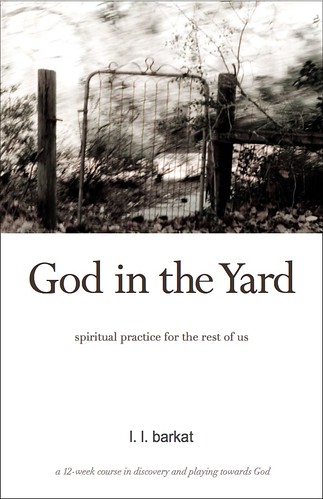
(for more on this issue, consult the chapter Poetry: Silence, in God in the Yard: Spiritual Practice for the Rest of Us.)

Labels: , , ,

8.9.11

What's Your Chair?

For a special project, I'm reading a book called A Sunlit Absence: Silence, Awareness, and Contemplation.

Hmmm.

I love the picture on the front. A gentle woman leaning in the shadows, arm on a book, quiet. I love the idea of silence and solitude (you know I do).

The book encourages us to choose a prayer chair on which to practice our silent moments ("quite googleable and not especially inexpensive"). I am wondering: couldn't a red sled do?

It also occurs to me that all of the examples so far, of successful contemplatives, were monks and nuns (and of course Jesus in the Wilderness). I wonder if these people were naturally introverted and drawn to the idea of silence. I have little doubt that they were childless.

I'm not judging the book yet (by its cover or anything else :), but I simply want to say that I truly wonder where the extrovert fits in a life of faith, where the woman with a few children hanging on her arms can find silence and solitude. I found some outdoors for a year, but it wasn't quite what the book I'm reading seems to have in mind.

Labels: , , , , ,

29.8.11

In Hymns

come thou fount in book

A long time ago, the girls and I would sit on the couch together and learn hymns. Somewhere along the line we stopped. Not sure why.

Recently, Sara told me she misses those times.

So this Sunday, I began a revival of the practice.

It fits very nicely with my focus for this year: music. And we are going to learn about the background of the hymns too.

We began yesterday with Come Thou Fount of Every Blessing. Sonia, my Littlest, sweetly researched the writer's life. We learned that Robert Robinson began as a barber; became a minister in Cambridge, England; wrote this hymn to go along with a sermon; and later fell into spiritual struggle and sorrow.

One day, many years after composing the hymn, Robinson met a woman in a carriage, who was humming his song. She asked how he liked the hymn. He began weeping and said, "I would give a thousand worlds, if I had them, to enjoy the feelings I had then."

Sonia also introduced us to John Wyeth (born in Cambridge, Mass), who added Robinson's hymn to a collection called the Repository of Sacred Music (which sold about 150,00 copies!). I couldn't help thinking how Robinson's words and music still made (and continue to make) an impact despite his difficulties. Maybe we are all like that, in our way.

The girls and I also looked up fountain in the Dictionary of Biblical Imagery. We read all the scriptures referenced and marveled about how Jesus is a "fount" because he is Wisdom itself (also called a "fountain" in Proverbs).

Our time together was so rich. Sonia even looked up the etymology of the word "fount," and it made me smile to know that it comes from the French verb "fondre," which means "to melt."

After all, I did my own share of melting as we sat together, learning, reading, and singing.


Labels: , , , , ,

1.8.11

In the Beginning, Music

I thought perhaps the world had started in silence.

Then I remembered Genesis. Hadn't there been a wind?

There are different ways to translate this stream of air that played across formless void and darkness. "A wind from God swept over the face of the waters." Or, "In the beginning God created mighty wind."

Wind, by itself, doesn't make a lot of sound. It needs something to push against, to lift and turn, to ruffle and rustle. So I'm not sure what the first sounds might have been like. If it was a mighty wind, perhaps there may have been a rushing, a roaring, as it swept across the waters or pushed liquid into certain boundaries.

When did the world come to understand such sounds in a way that felt more "musical"? Who first hummed along, added a drum to the rushing of wind? Perceived the tapping of rain as a rhythm?

I don't know.

But this morning I am thankful to God for the gift of sound, and a voice to echo what He began.

Labels: ,

30.7.11

Bread (and Taxes?) and a Little Bach

You know I've been thinking about where to journey next.

Ever since I spent a year outdoors each day, I've embraced the idea of focusing on something for 12 months. Not in a rigid way. But in a manner that promises growth and surprises.

After the year outdoors, I embarked on an Art Pilgrimage. Along the way, I decided I might spend four whole years with the arts: Visual, Dance, Music, Theater.

When July came around this year, though, I wondered if I might skip Music. I don't know why. I just did.

Until today.

Listening to cultural icon Lady Gaga, I was struck by the complexity of her music. She seems like fluff, and her lyrics are over-the-top and sometimes naughty, but she is linked to the past through sound. I wanted to be able to tell my daughter what these links to the past were. I could sense them, but I couldn't place them— everything from Rock, to spirituals, to classical, to 80's pop seemed woven in and around Gaga's sounds.

That's when I made my decision. I will go with Music this year. As always, I don't know where this will take me. But I can hear, almost like a song, the possibilities.

Beyond sound, there'll be bread, for the girls and I. Last year we focused on Tea and learned so much about it, including how it influenced international economic policy in Britain. We all agreed that bread would be equally enchanting and historical, even biblical.

So the year is before us: Bread (and taxes?), a little Bach and the roots of music like Gaga's. I'm already tapping my feet (and the edge of my plate :).

Labels: ,